Digitization made county property records easier to access, but it also created a serious vulnerability. Bots, scrapers, and AI systems can now pull massive amounts of public record data at a speed and scale that public records laws never anticipated. What was once human-paced access has become automated extraction, creating new pressure on county portals, new privacy concerns for residents, and new exposure for the officials responsible for maintaining these systems.
For county clerks, recorders, assessors, and public-sector technology teams, this is no longer a future concern. It is already affecting public records operations through bulk requests, commercial harvesting, AI-assisted fraud, and rising downstream misuse of county-sourced data. The question is no longer whether public records systems are being exploited. The question is whether counties will act before the damage becomes harder to reverse.
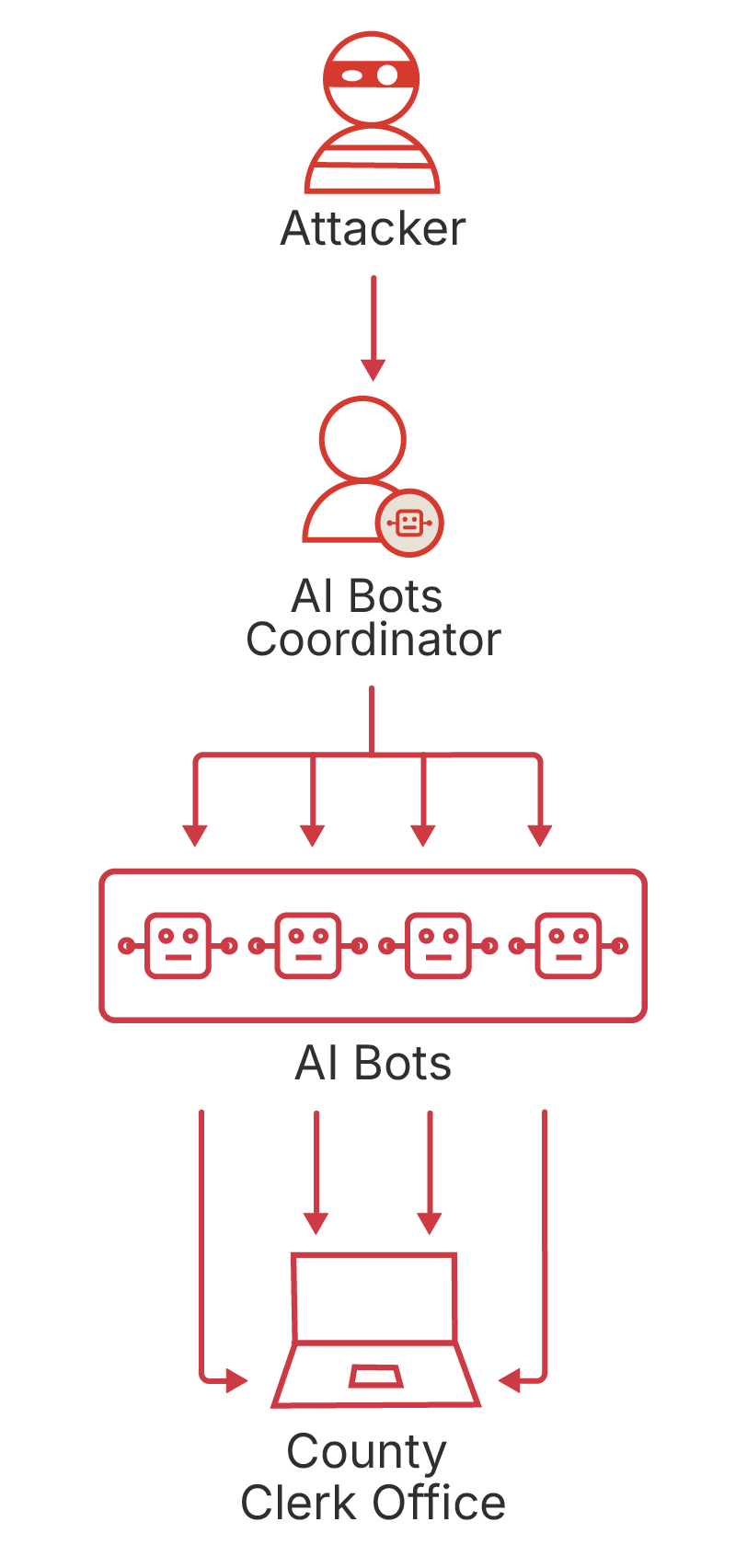
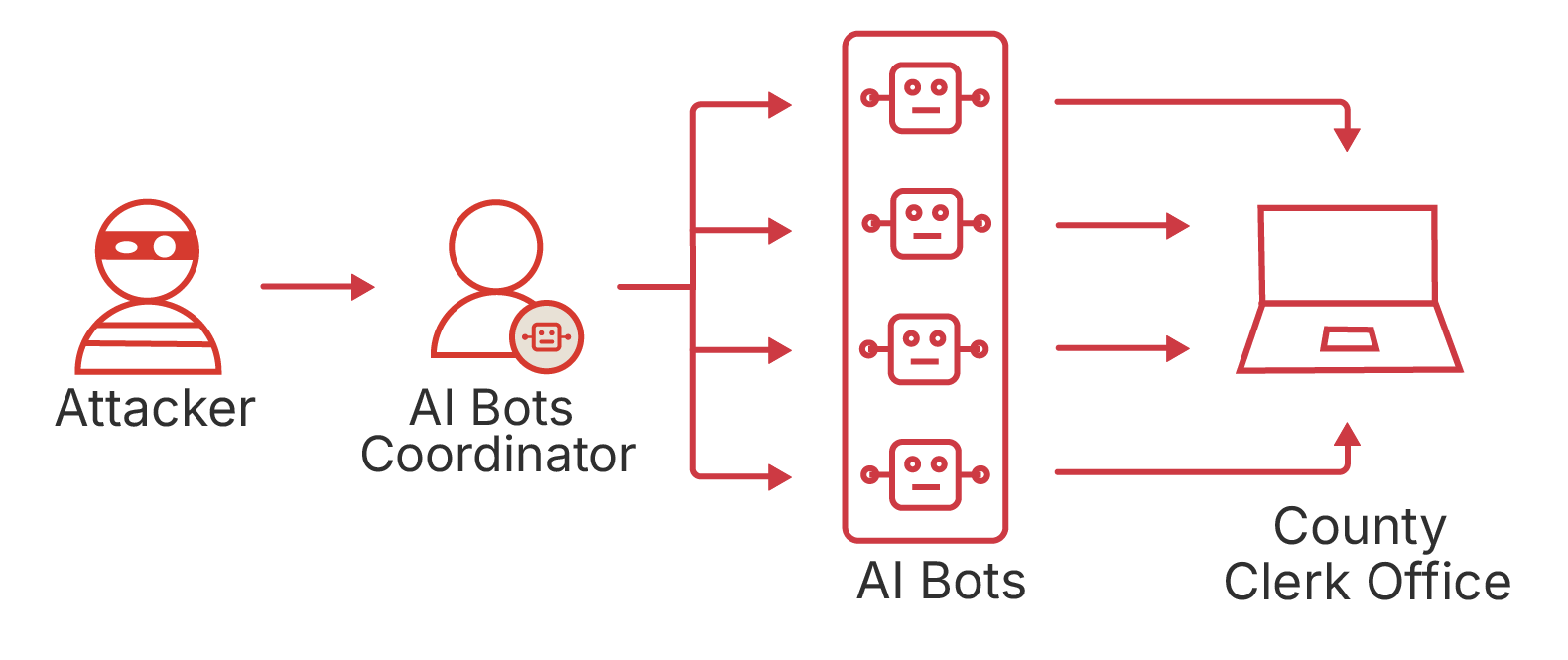
Artificial intelligence is rapidly transforming how public records are accessed—especially through Large Language Models (LLMs) and automated data extraction tools. What was once manual, intentional use of county systems is now being replaced by high-speed, large-scale automation.
County public record systems were never designed to handle continuous, machine-driven queries. Today, automated systems can run thousands of searches, extract structured datasets, and replicate entire databases—often without visibility or control from the counties themselves.
This shift is creating real consequences. System performance is impacted, sensitive information becomes easier to aggregate, and the line between responsible access and bulk exploitation continues to blur. What was built for transparency is now being leveraged at a scale that introduces new privacy, security, and operational risks.
Public records websites are now exposed to automated tools that can harvest names, addresses, purchase prices, mortgage balances, signatures, and filing patterns in bulk. Public Records Safety cites Solove and Hartzog’s 2025 paper The Great Scrape as a key marker of this shift, arguing that mass scraping collides with core privacy principles such as fairness, consent, purpose limitation, data minimization, and security.
The problem is not limited to outside attackers. County data is often flowing into commercial ecosystems through bulk sales, unrestricted APIs, open data portals, direct feeds, and vendor agreements with little downstream oversight. The Public Records Safety page points to large-scale commercial pipelines such as ATTOM, CoreLogic, BatchData, and DataTree to illustrate how county-originated records can quickly become part of national data products.
Many counties are still not asking the operational questions that matter most: who is accessing bulk data, what restrictions apply after the data leaves county control, whether downstream use is enabling stalking or fraud, and whether privacy impact assessments are occurring before agreements are signed. That gap turns a records-access issue into a governance issue.
The same page warns that AI can accelerate forged deeds, deepfake identities, and fraudulent transfer schemes. It also cites a documented real estate transaction example from First American Title involving an AI-generated deepfake participant on a video call, showing how title-related fraud is evolving alongside the data environment that supports it.
County systems were built around the idea of public access, not nonstop industrial harvesting. That difference matters. A resident, journalist, attorney, or abstractor conducting a legitimate search is not the same as an automated system vacuuming up records continuously. Once access shifts from human-scale use to machine-scale extraction, counties face heavier portal loads, higher support burdens, more privacy risk, and less control over how their data is ultimately used.
Whether a county is trying to reduce portal strain, strengthen privacy protections, or limit downstream misuse of its data, the problem touches multiple operational areas at once. Public Records Safety frames the issue across scenarios such as:
This is not just a cybersecurity issue. It is also a privacy issue, a public administration issue, and a trust issue. The harms described on the Public Records Safety page include exposure for domestic violence survivors, elevated title fraud targeting elderly homeowners, wider risk for all property owners, and pressure on title professionals who depend on accurate, responsibly accessed records. Counties are not simply defending servers; they are protecting the integrity of public access itself.
County teams often have to deal with the consequences long before the broader public understands what is happening. Public Records Safety highlights several areas where the effects are already visible:
The page explains that public record data can expose home addresses that abusers may use to locate relocated victims. It notes that address confidentiality efforts can be undermined when the same information becomes available again through commercial aggregators.
Older homeowners, especially those with mortgage-free and high-equity properties, are identified as major targets for deed fraud. Public Records Safety cites the 2025 NAR survey saying 63% of real estate professionals were aware of title fraud in the previous 12 months, with awareness rising to 92% in the Northeast.
The risk is broader than any one group. The page ties large-scale data harvesting to AI-assisted fraud techniques that can support false identities, forged signatures, and fraudulent transfers. In that environment, easy bulk access to property data becomes part of the attack surface.
Public Records Safety also notes that experienced abstractors and title professionals still catch nuances that automated systems miss, including misspelled indices, misfiled entries, and local recording quirks. That means uncontrolled automation threatens both system integrity and practical accuracy.
The page also makes clear that this issue is already moving into legislation and policy. It cites 50 public-sector AI legislative proposals introduced in 2025 state sessions, references Indiana’s 2026 anti-bot momentum, and points to Colorado’s AI Act taking effect in June 2026. It also notes that some states have adopted filing alerts, suspicious-document holds, photo ID requirements, or title-freeze style protections.
Everything you need to advocate for public records protection in your county. Download, print, and share.
Enter a county name to check its protection status